Types of Water Reducing Admixtures and Their Applications in Modern Concrete
Concrete is the backbone of modern construction, and its performance relies heavily on chemical additives that improve workability, strength, and durability. Among these additives, water reducing admixtures are critical for producing high-quality concrete with reduced water-cement ratios. From mid range water reducer solutions to high range water reducer concrete formulations, these admixtures play a key role in achieving sustainable and high-performance structures.
This article explores the types of water reducing admixtures, their applications, and the benefits of modern polycarboxylate-based superplasticizers, including PCE and PCE polycarboxylate ether, in concrete construction.
Types of Water Reducing Admixtures
Normal, Mid-Range, and High-Range Admixtures
Water reducing admixtures can be categorized into three main types based on the level of water reduction and performance required:
Normal Water Reducing Admixtures
These reduce water content by 5–10% and improve the flow and workability of concrete without significantly affecting setting time. They are ideal for general construction applications where standard strength and durability are sufficient.
Mid Range Water Reducer
Also called mid range concrete additive or mid range water reducing admixture, this type reduces water by approximately 10–15%. Mid range water reducer in concrete ensures consistent workability and is commonly used in ready-mix concrete, floor screeds, and applications where moderate water reduction is required. These admixtures act as a water reducing agent in concrete, helping achieve higher strength and improved durability without drastically altering slump.
High Range Water Reducer (HRWR)
High range water reducer concrete formulations, often referred to as HRWR superplasticizer, reduce water content by 20–30% while maintaining excellent flowability. This type is crucial for self-compacting concrete, high-strength precast elements, and other applications requiring high-performance concrete. Polycarboxylates high range water reducer are a common solution in modern construction due to their superior dispersion of cement particles.
Polycarboxylate-Based Superplasticizers
The development of polycarboxylate-based superplasticizers has revolutionized the concrete industry. Unlike traditional admixtures, polycarboxylate ether PCE provides exceptional water reduction, longer slump retention, and improved early and long-term strength.
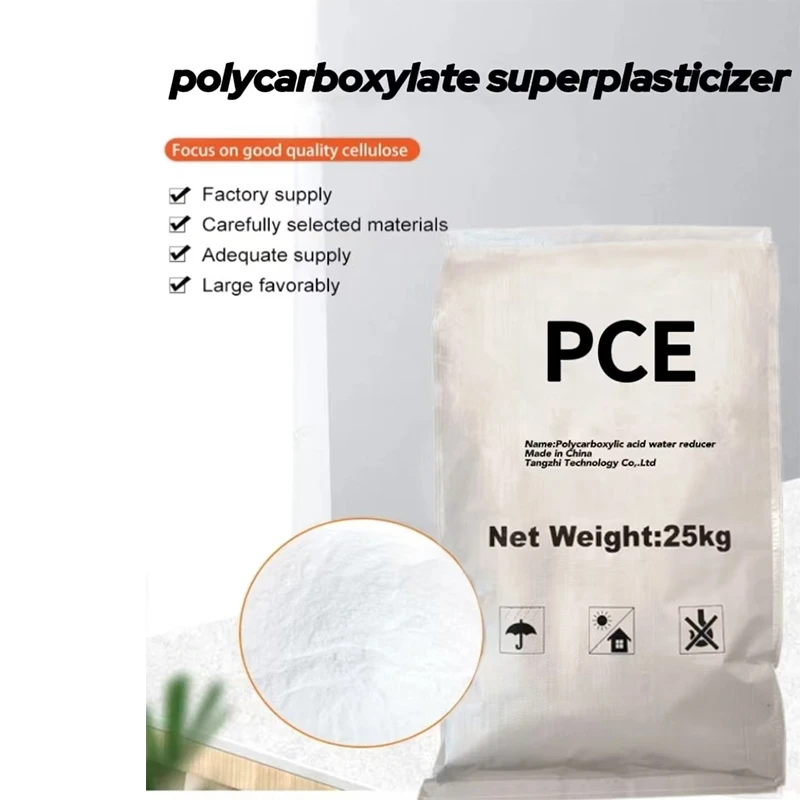
PCE polycarboxylate ether and PCE polycarboxylate superplasticizer are commonly used to produce high range water reducer concrete with excellent fluidity and minimal segregation. PCE water reducer and PCE plasticizer are versatile solutions suitable for both precast and cast-in-place concrete.
Key advantages of polycarboxylate plasticizer and polycarboxylate ether superplasticizer PCE include:
Reduced water-cement ratio without compromising workability.
Increased compressive and flexural strength.
Enhanced durability and resistance to shrinkage and cracking.
Compatibility with a wide range of cement types.
Additionally, PCE P products are specialized high-performance variants designed for demanding construction applications, offering superior performance in hot climates or long-distance transportation of ready-mix concrete.
Applications of Water Reducing Admixtures
Improving Concrete Workability and Strength
Water reducing admixtures in concrete are widely used to enhance both workability and strength. Mid range water reducer solutions are ideal for applications that require moderate fluidity, while high range water reducer concrete formulations are essential for high-strength and self-consolidating concrete.
Concrete water reducer plasticizer and concrete additive water reducer superplasticizer help achieve uniform flow, reducing the need for mechanical vibration and improving compaction. These benefits make them suitable for infrastructure projects, high-rise buildings, and precast elements.
Specialized Applications in Modern Construction
Polycarboxylate ether PCE and polycarboxylate-based superplasticizer solutions are widely applied in:
Precast Concrete Elements: High fluidity and rapid early strength development.
Self-Consolidating Concrete (SCC): Exceptional flow without segregation.
High-Strength Concrete: Reduced water content increases compressive strength and durability.
Large-Scale Construction Projects: Uniform workability and consistent performance for long pours.
The application of water reducing admixtures extends beyond traditional construction, supporting sustainable practices by reducing cement consumption and enhancing the longevity of structures.
Conclusion
The types of water reducing admixtures—from mid range water reducing admixture to high range water reducer concrete—are essential for modern concrete construction. HRWR superplasticizer, polycarboxylate ether superplasticizer PCE, and PCE polycarboxylate ether provide superior water reduction, workability, and strength.
By integrating mid range water reducer in concrete and polycarboxylate-based superplasticizer solutions, contractors and engineers can optimize concrete mixes for both performance and sustainability. The application of water reducing admixtures ensures that modern concrete structures are stronger, more durable, and more cost-effective.
FAQs About Water Reducing Admixtures
1. What are the main types of water reducing admixtures?
The main types are normal water reducers, mid range water reducer, and high range water reducer concrete (HRWR superplasticizer). Each type offers different levels of water reduction and workability enhancement.
2. How does mid range water reducer in concrete improve performance?
Mid range water reducer in concrete reduces water by 10–15%, improving flow, consistency, and durability. It is ideal for ready-mix concrete and general construction projects.
3. What is PCE and why is it used in modern concrete?
PCE (polycarboxylate ether) disperses cement particles efficiently, reduces water demand, and improves slump retention. Variants like PCE P and PCE polycarboxylate superplasticizer are used for high-performance concrete applications.
4. What are the advantages of using high range water reducer concrete?
High range water reducer concrete or HRWR superplasticizer allows water reduction up to 30%, producing high-strength, self-consolidating, and durable concrete suitable for large-scale and critical infrastructure projects.
5. What is the application of water reducing admixtures in modern construction?
The application of water reducing admixtures includes improving workability, reducing water-cement ratio, increasing strength, and enhancing durability. They are used in precast elements, SCC, high-rise buildings, and infrastructure projects.
-
HPMC High-Performance Thickener | Hebei TangzhiNewsMar.06,2026
-
Wholesale Water Reducing Admixture for Special Cement: Performance and Market InsightsNewsFeb.28,2026
-
The Complete Guide to HPMC: Types, Applications, Grades, and Manufacturing InsightsNewsFeb.28,2026
-
Redispersible Polymer Powder: Types, Applications, and Performance AdvantagesNewsFeb.28,2026
-
Hydroxymethyl Ethyl Cellulose (MHEC): Properties, Applications, and Market InsightsNewsFeb.28,2026
-
Hydroxyethyl Cellulose: Applications, Performance, and Buying GuideNewsFeb.28,2026