Water Reducer For Modern Concrete
As cities expand and construction demands increase, builders and engineers face higher expectations for concrete performance. Stronger, more durable, and more workable concrete is essential to meet modern infrastructure standards. Among innovations in construction chemistry, water reducer stands out as a critical solution for improving concrete quality, efficiency, and sustainability.
From skyscrapers to bridges, precast structures to dams, water reducer plays a key role in ensuring consistent quality while reducing material costs. Modern construction projects rely on these chemical admixtures to enhance flowability, strength, and durability without compromising environmental standards.
Water Reducer Practical Role In Daily Projects
water reducer is primarily designed to reduce the amount of water needed in concrete mixing while maintaining fluidity. By doing so, it improves the water-cement ratio, which directly impacts concrete strength and durability.
water reducer allows construction teams to achieve smoother concrete mixes that are easier to pump, transport, and place, particularly in large-scale projects where continuous flow is necessary.
water reducer improves slump retention, preventing early hardening or segregation during long transport or hot-weather conditions. This ensures uniform concrete quality across different batches.
water reducer supports labor efficiency by making concrete easier to handle on-site, reducing physical strain, equipment wear, and the likelihood of errors during mixing or placement.
water reducer also contributes to sustainable construction. Lower water requirements reduce cement usage, which in turn decreases carbon emissions and helps projects meet green building standards.
Polycarboxylate Concrete Admixture Market Trend
polycarboxylate concrete admixture is the modern choice for high-performance concrete. It has rapidly gained popularity because of its superior water-reducing capacity compared to traditional naphthalene or lignin-based admixtures.
polycarboxylate concrete admixture works at low dosage levels to provide high efficiency, which allows construction companies to reduce costs without sacrificing performance.
polycarboxylate concrete admixture is compatible with various cement types and supplementary materials, reducing risk of material incompatibility and ensuring uniform concrete quality.
polycarboxylate concrete admixture is widely used in ready-mix concrete, precast components, and high-strength concrete applications. Its versatility makes it suitable for complex architectural projects and large civil engineering structures.
polycarboxylate concrete admixture is increasingly specified in green construction projects and large-scale tenders due to its efficiency, sustainability, and compliance with modern environmental regulations.
Polycarboxylate Concrete Strength And Durability
polycarboxylate concrete achieves superior compressive and flexural strength thanks to improved cement particle dispersion and enhanced hydration efficiency.
polycarboxylate concrete reduces internal voids and permeability, resulting in a denser microstructure. This provides excellent durability and resistance against chemical attack, freeze-thaw cycles, and abrasion.
polycarboxylate concrete maintains better surface finish, which is important for precast panels, exposed architectural elements, and infrastructure requiring aesthetic quality.
polycarboxylate concrete is effective in self-consolidating concrete (SCC), allowing the mix to flow easily into complex molds or forms without mechanical vibration.
polycarboxylate concrete improves long-term performance of structures, making it suitable for bridges, high-rise buildings, dams, tunnels, and precast concrete components.
Polycarboxylate Ether Technology Advantage
polycarboxylate ether is the core technology behind high-performance superplasticizers. Its structure combines polyether macromolecules with carboxylic acid groups to maximize efficiency in water reduction.
polycarboxylate ether creates electrostatic repulsion and steric hindrance between cement particles, preventing flocculation and maintaining uniform dispersion in the mix.
polycarboxylate ether typically achieves water reduction rates of 25–40%, which is significantly higher than traditional naphthalene or lignin-based water reducers, enabling stronger concrete at lower water content.
polycarboxylate ether prolongs slump retention and ensures consistent workability, crucial for long pours, transportation, and intricate construction elements.
polycarboxylate ether contributes to sustainable construction by reducing cement usage, lowering CO₂ emissions, and minimizing waste during production, aligning with modern green building initiatives.
Polycarboxylate Ether FAQs
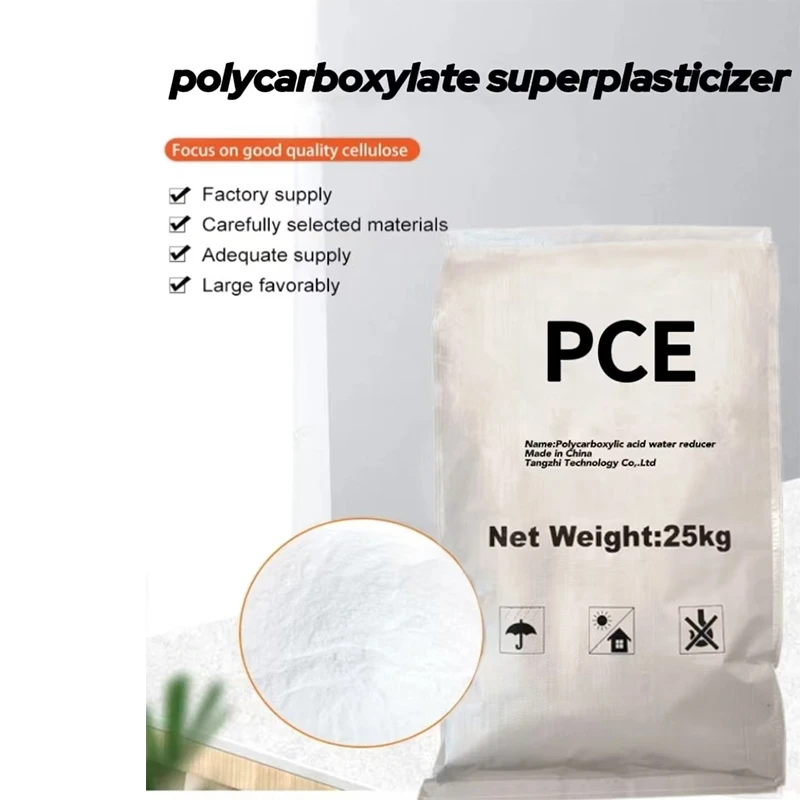
polycarboxylate ether superplasticizer has become a central component in modern concrete technology. Polycarboxylate Ether Superplasticizer (PCE) is a high-efficiency admixture widely used in construction engineering. With polyether macromolecules and carboxylic acid groups, PCE improves concrete performance through electrostatic repulsion and steric hindrance. It reduces water consumption, enhances strength, maintains fluidity, and supports sustainable building practices.
Selecting a high-quality polycarboxylate ether ensures reliability across diverse projects. Professional manufacturers provide multiple grades, technical support, and tailored solutions. You can consult technical teams, request samples, or order directly from official websites to access consistent, high-quality products. Choosing the right PCE today improves concrete quality, construction efficiency, and long-term project performance.
What Is The Main Function Of A Water Reducer?
A water reducer lowers water usage while maintaining workability, improving concrete strength and durability.
Why Is Polycarboxylate Admixture Better Than Traditional Types?
It provides higher water reduction, lower dosage, longer slump retention, and better environmental performance.
Where Is Polycarboxylate Concrete Commonly Used?
It is widely used in bridges, dams, high-rise buildings, precast components, and commercial concrete.
How Does Polycarboxylate Ether Work In Concrete?
It disperses cement particles through electrostatic repulsion and steric hindrance, preventing aggregation and maintaining flow.
Where Can I Buy Reliable Polycarboxylate Ether Products?
Professional manufacturers sell PCE via official websites, offering technical support, multiple grades, and safe shipping options.
-
HPMC High-Performance Thickener | Hebei TangzhiNewsMar.06,2026
-
Wholesale Water Reducing Admixture for Special Cement: Performance and Market InsightsNewsFeb.28,2026
-
The Complete Guide to HPMC: Types, Applications, Grades, and Manufacturing InsightsNewsFeb.28,2026
-
Redispersible Polymer Powder: Types, Applications, and Performance AdvantagesNewsFeb.28,2026
-
Hydroxymethyl Ethyl Cellulose (MHEC): Properties, Applications, and Market InsightsNewsFeb.28,2026
-
Hydroxyethyl Cellulose: Applications, Performance, and Buying GuideNewsFeb.28,2026